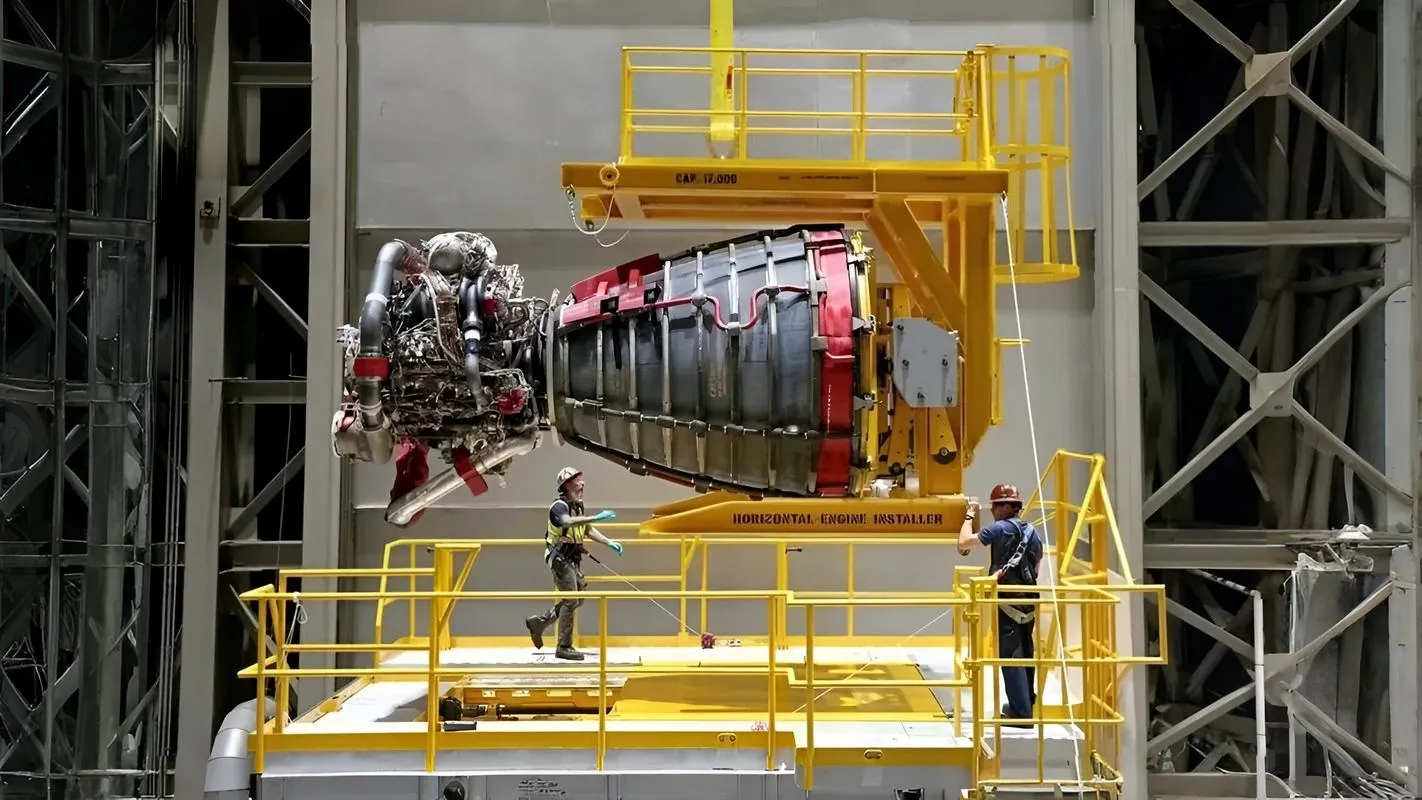
As NASA prepares to launch its massive Space Launch System (SLS) for the Artemis 2 mission, the agency is bridging two eras of spaceflight. When the 5.75-million-pound rocket blasts off—targeting a launch as early as February 6—it will be powered by engineering legends.
Three of the four RS-25 engines at the base of the rocket are not new; they are veterans of the Space Shuttle program, having already flown to orbit on iconic missions like the final flight of Atlantis and the repair of the Hubble Space Telescope.
Old Engines for a New Era
On January 17, NASA rolled the fully stacked SLS rocket onto the launch pad at Kennedy Space Center. This marked a major milestone for Artemis 2, which aims to send a team of astronauts back to lunar space for the first time in over 50 years.
While the mission is forward-looking, the hardware is steeped in history. L3 Harris Technologies’ Aerojet Rocketdyne division, which built the engines for the shuttle program (1981–2011), refurbished these powerhouses for one final, glorious flight.
Here is the incredible backstory of the specific engines powering this mission.
Engine E2047: The Veteran
History: 15 Space Missions Engine 2047 is the heavy lifter of the group. It has flown on 15 previous missions, most notably powering the final space shuttle mission in July 2011. It was the first engine installed in the SLS core stage for Artemis 2, cementing its place as a bridge between the shuttle era and the Artemis generation.
Engine E2059: The Hubble Repairman
History: 3 Space Missions Engine 2059 has a storied resume involving one of science’s greatest instruments. It helped power the space shuttle Atlantis on three missions:
- Two flights to the International Space Station (ISS) in 2007 and 2008.
- The historic Hubble Space Telescope servicing mission in 2009.
This engine was the last of the group to be transported from Kennedy Space Center to the Stennis Space Center in Mississippi for testing and integration.
Engine E2061: The Station Builder
History: ISS Assembly Missions Engine 2061 is inextricably linked to the space shuttle Endeavour. It powered the shuttle during its 32nd mission in 2010, which delivered the Tranquility node and cupola to the ISS—the very window through which astronauts now view the Earth. It also flew on Endeavour’s 25th and final flight, delivering the Alpha Magnetic Spectrometer to the station.
The STS-1 Connection
In a remarkable nod to continuity, all four RS-25 engines on the Artemis 2 rocket—including the one making its launch debut—contain at least one component that flew aboard STS-1 in 1981. That means parts of this rocket were present for the maiden voyage of the space shuttle Columbia, the very first orbital flight of a reusable spacecraft.
A One-Way Ticket to the Ocean
Despite their rich history and “reusable” heritage, these engines are facing their final curtain call. Unlike the space shuttle, the SLS is a fully expendable rocket.
Roughly 10 minutes after liftoff, after propelling the Orion capsule toward the Moon, the core stage will separate and fall back to Earth. These historic engines, with their combined 22 previous missions, will end up at the bottom of the Atlantic Ocean, never to be recovered. It is a bittersweet, “sad but true” finale for pieces of hardware that have defined American spaceflight for four decades.