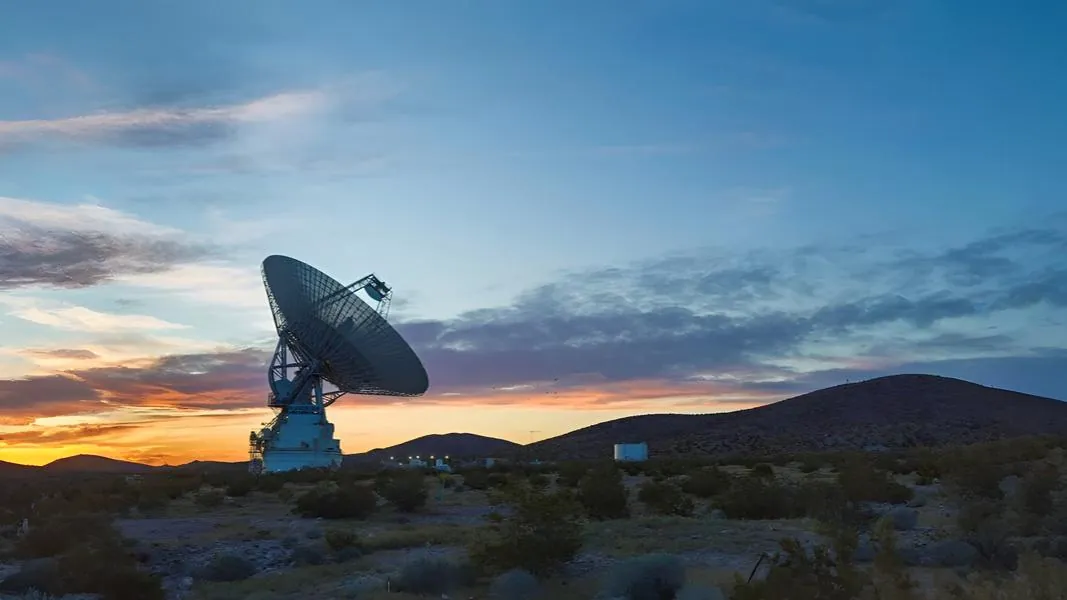
NASA’s ability to communicate with deep space missions has taken a significant hit. A massive, 230-foot-wide radio antenna, a cornerstone of the agency’s Deep Space Network (DSN), has been offline for nearly two months following a damaging mechanical failure.
The incident comes at a precarious time for the space agency. With the aging infrastructure of the Deep Space Network already operating at capacity and a government shutdown complicating the flow of information, the timeline for repairs remains unclear.
The Incident: Over-Rotation and Flooding
The trouble began on September 16 at the DSN site in Goldstone, California. The antenna, officially known as DSS-14, went dark after it “over-rotated,” a mechanical error that placed severe strain on the critical cabling and piping located at its center.
According to a statement from NASA’s Jet Propulsion Laboratory (JPL), the damage was not limited to structural components. The hoses from the antenna’s fire suppression system were also compromised during the incident, leading to flooding and water damage within the facility.
NASA has since established a “Mishap Investigation Board” to determine exactly how the over-rotation occurred. However, transparency regarding the path forward has been hindered by political factors. A JPL spokesperson confirmed that while there is “no danger to the public,” detailed information on the board’s findings and the next steps for repairs will only be provided “after the federal government reopens”.
Currently, the antenna remains offline while engineers and technicians evaluate the structure to make repair recommendations.
A Network Under Pressure: The Capacity Crisis
The loss of DSS-14 is not just an isolated equipment failure; it exacerbates a long-standing issue with NASA’s communications infrastructure. Established in 1963, the network of antennas is currently operating at absolute capacity.
A 2023 report by NASA’s Office of Inspector General painted a stark picture of the network’s health:
- Demand Exceeds Supply: Ongoing space missions frequently request more communication time than the network can provide, with demand exceeding supply by as much as 40% at times.
- Future Strain: The report anticipates that demand will increase dramatically in the coming decade, potentially exceeding capacity by 50% by the 2030s.
With DSS-14 down, extra strain is immediately shifted onto the remaining functioning parts of NASA’s communications network, creating a bottleneck for data transmission.
The “Mars Station”: A Legacy of Exploration
The damaged antenna is one of the most storied pieces of hardware in space exploration history. Nicknamed the “Mars station,” DSS-14 has been instrumental in some of humanity’s greatest achievements.
- 1966: It received its first signal from the Mariner 4 mission, the first spacecraft to successfully fly by Mars.
- 1988: The dish was upgraded from 64 meters (210 feet) to its current 70 meters (230 feet) to prepare for Voyager 2’s historic encounter with Neptune.
- 2012: It was used to communicate with Voyager 1 as it ventured into interstellar space.
Today, its high sensitivity makes it crucial for sending commands to deep space missions and tracking near-Earth asteroids to measure their size and trajectories.
The Artemis Problem
The timing of this outage is particularly concerning for NASA’s flagship Artemis program, which aims to return humans to the Moon. The agency plans to launch Artemis 2, a crewed mission around the Moon, as early as February 2026.
The demand Artemis places on the Deep Space Network is massive:
- Artemis 1: Launched in November 2022, this mission required 903 hours of DSN time.
- Secondary Payloads: The mission’s eight cubesats required an additional 871 hours.
With such high requirements, it is difficult to imagine successfully launching and monitoring Artemis 2 with one of the network’s largest antennas out of service.
How the Deep Space Network Works
To understand the gravity of the situation, one must look at how the DSN is structured. The network relies on three major facilities strategically placed approximately 120 degrees apart around the globe:
- Goldstone, California (Mojave Desert).
- Madrid, Spain.
- Canberra, Australia.
This geometric spacing ensures that as the Earth rotates on its 360-degree axis, at least one facility is always positioned to communicate with any given spacecraft. When one site goes down—like the outage in Madrid in 2006 or the 11-month upgrade in Australia in 2020—it leaves a blind spot that puts pressure on the rest of the system.
With the clock ticking toward the next Artemis launch, NASA engineers face a tight deadline to revive the giant of Goldstone.