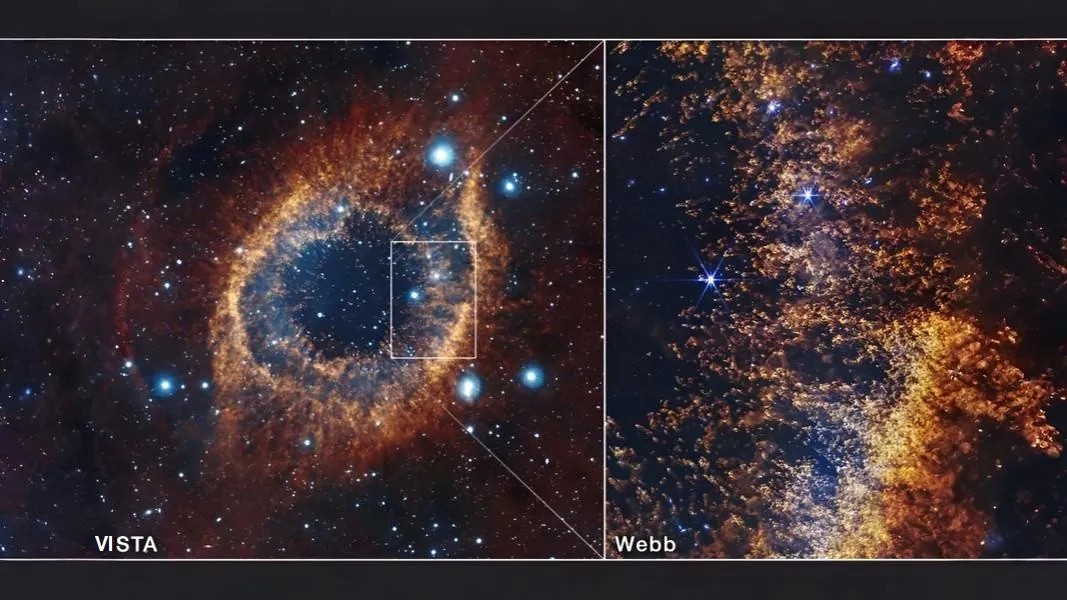
The James Webb Space Telescope (JWST) has turned its powerful gaze toward one of the most iconic sights in our night sky: the Helix Nebula. Often referred to as the “Eye of God” or the “Eye of Sauron” due to its piercing, eye-shaped appearance, this celestial wonder has been revealed in unprecedented detail.
A new, stunningly detailed image captures a zoomed-in view of the nebula, peeling back the layers of darkness to expose “fiery pillars,” comet-like knots, and the complex mechanics of a dying star.
A “Cosmic Lasagna” of Gas and Dust
Using its Near-Infrared Camera (NIRCam), Webb has managed to bring a small, intricate portion of the Helix Nebula into full view. The high-resolution imagery reveals a chaotic yet beautiful landscape where winds of fast-moving, hot gas crash into slower, colder shells of gas and dust that were shed by the star earlier in its life.
This collision creates the nebula’s unique shape and complex layering. The radiation from the dying star illuminates the surrounding gas, creating a structure that astronomers have likened to a “cosmic lasagna” due to its distinct layers of material.
- The Center: Closest to the white dwarf lies hot, ionized gas.
- The Middle: Further out, the gas cools into clearer molecular hydrogen.
- The Outer Shell: Protective pockets form within dust clouds, allowing more complex molecules to begin taking shape.
Decoding the Colors: A Temperature Map
In this new Webb image, color is more than just an aesthetic choice; it is a scientific map representing temperature and chemistry.
- Blue Hues: These areas mark the hottest gas in the field, energized by the intense ultraviolet light streaming from the white dwarf.
- Yellow Regions: Moving farther out, the gas cools, allowing hydrogen atoms to bond and join into molecules.
- Reddish Tones: At the nebula’s outer edges, the red tones signify the coolest material, where thinning gas eventually gives way to dust formation.
The Engine of the Nebula: A Dying Star
At the heart of the Helix Nebula sits a blazing white dwarf—the leftover core of a dying star. While this white dwarf is technically “out of the frame” of Webb’s specific zoomed-in image, it is the engine driving the entire spectacle.
The star releases an “avalanche of material” that crashes into the colder surrounding shells. This violent process is not merely destructive; it is a form of cosmic recycling. The nebula demonstrates how stars release layers of gas to “seed the cosmos,” providing the raw material that could eventually mold itself into future generations of stars and planetary systems.
A Glimpse of Our Own Fate
Beyond its visual splendor, the Helix Nebula offers a sobering and scientific look at the future of our own solar system. The image provides a rare glimpse into the fate of stars like the Sun. Once our Sun reaches the end of its life cycle, it too will shed its outer layers, recycling its own material to birth new systems, just as the Helix Nebula is doing now.
Ideally Located for Observation
The Helix Nebula has been a favorite target for astronomers since it was first spotted in the 1800s. Its popularity stems from both its striking, eye-like shape and its relative proximity to Earth.
Located just 650 light-years away in the constellation Aquarius, it is one of the closest of all bright planetary nebulae to Earth. Over the years, astronomers have utilized both ground-based and space observatories to stare into this “Eye of Sauron,” but few have captured the “final moments of a dying star” with the clarity provided by the Webb telescope.