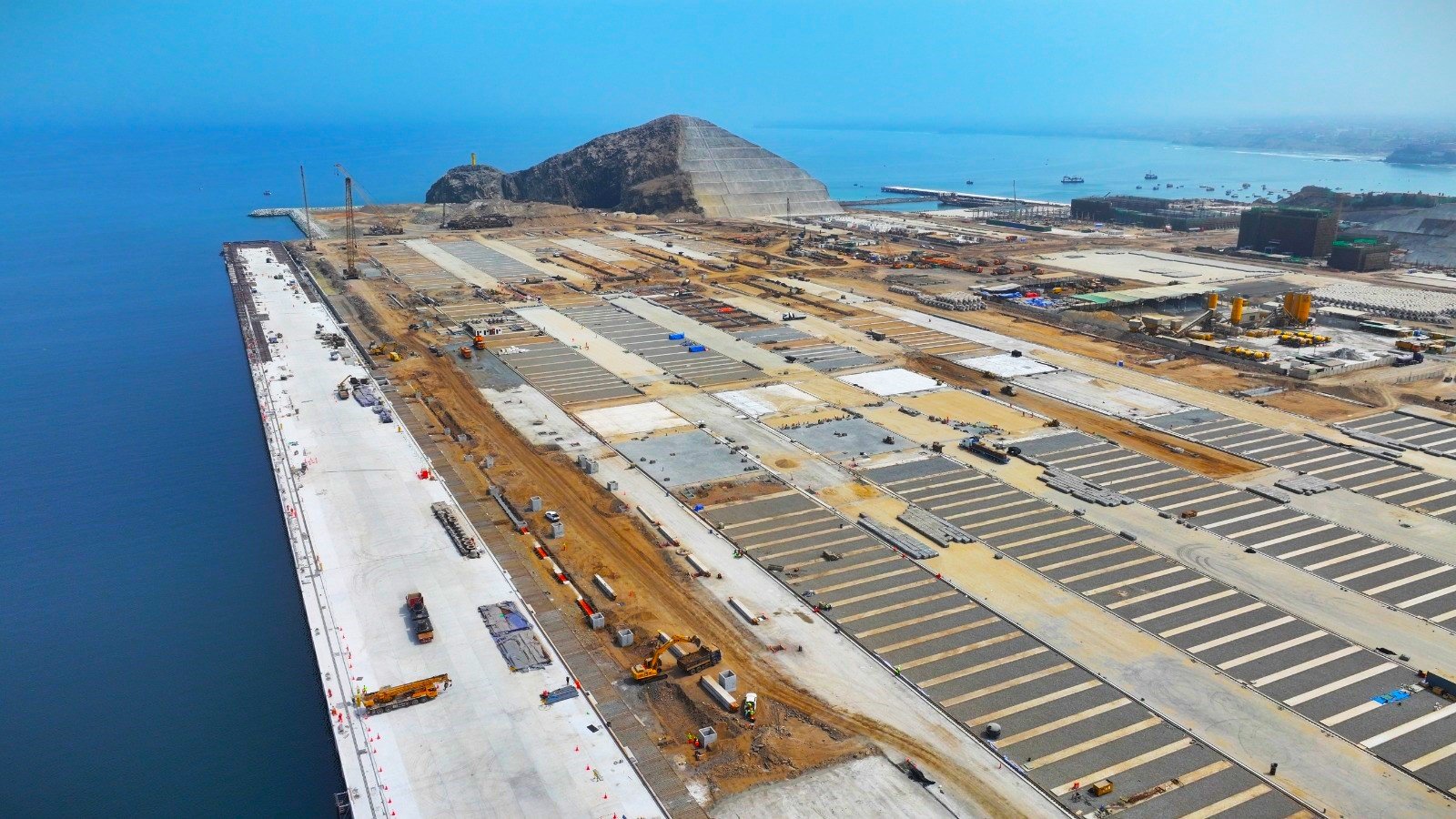
Chankai Megaport, which will start operating in November, will allocate up to $250 million in advanced technology to become the first smart port in the South Pacific, according to a report by Capechi Trade, the magazine of the Peru-China Chamber of Commerce (Capechi).
“Cosco Shipping has allocated between $200 million and $250 million for the acquisition of equipment and technology systems that will be implemented by Chankai Megaport, which is part of the $1.3 billion port-first investment,” he reveals.
It will be the first smart port in the South Pacific
According to the report, the implemented technology is transforming logistics operations in South America, improving the efficiency of maritime transportation in the country and the region and setting new standards in the South American port industry.
“The advanced technology that will transform the Changkai megaport into the first smart port in the South Pacific, which became evident after the arrival of the first ship from China on June 14 with five yard cranes and the second ship on June 27 with the first two gantry cranes that will be part of its facilities,” he adds.
For his part, Carlos Ortiz, Operations Manager of Cosco Shipping Ports Chancay Perú, explained to Capechi Trade that both the yard cranes and the container gantry cranes, which are responsible for loading and unloading containers to and from the dock, will be fully automated, operate without the intervention of personnel on board and comply with the parameters of the terminal’s operating system.
The technology will allow to optimize activities in the megaport
In this way, the risk of accidents is reduced and effective continuous work is guaranteed 24 hours a day, which will allow to achieve optimal indicators of productivity and cargo movement during import-export operations.
“If in other terminals it takes an average of 16 hours for a ship to stay (with 2,000 container movements), then in Chankai megaport it will take only 8-10 hours. This will make it possible to reduce logistics costs by at least 20%, he estimated.
In this context, Carlos Aquino, director of the Center for Asian Studies at the National University of San Marcos Mayor, said that “without a doubt, new technologies will streamline and secure work, leading to lower costs and increased competitiveness.”
“All this, as well as shortening the distance from Changkai to Asia by direct route, means less time and again lower costs and greater competitiveness not only of the goods that are already exported, but also of new products,” he added.
Chinese companies will supply advanced technologies
According to Capechi Trade, to integrate advanced technology, Cosco Shipping Ports Chancay Peru has contracted with Chinese companies to provide the necessary equipment, such as Shanghai Zhenhua Heavy Industries Company (ZPMC), which will provide 15 yard cranes, six container dock gantry cranes and six multi-purpose dock cranes.
All this equipment will be mounted on rails, which ensures precise movement and eliminates the risk of derailment, unlike machines mounted on wheels. Both yard cranes and gantry container cranes will be fully automated, while cranes designed for multi-purpose docks (bulk and roll-on) will have an operator on board.
On the other hand, the Chinese company Nezha will provide a port operating system that will be interconnected with all terminal connection devices through a big data network supported by a private 5G network. Carlos Ortiz clarified that this network, supplied by Claro, will increase the bandwidth to connect more equipment, thus minimizing system outages.
The installation of 5G technology will benefit communication between equipment and facilitate the implementation of facial recognition systems to identify workers and users, making work faster and safer.
Technological advancements will be rolled out at all Changkai megaport facilities, including the use of 40 intelligent vehicles that will transport containers from the dock to the container yard.
The multi-purpose dock will use cameras and QR codes, among other things, to optimize monitoring of the unloading of moving goods. In addition, both the vehicles and the cranes (both yard and dock) will be powered by electricity, which will contribute to environmental sustainability.
READ ALSO: The MEF is establishing a customs administration to take part in operations at the Changkai megaport
Chancay Megaport will have trained personnel
Capechi Trade also notes that the adoption of these modern technologies in Changkai Megaport will require properly trained personnel to operate the automated equipment and manage the entire terminal operating system, which poses a significant challenge given that the country currently lacks workers with experience in automated ports.
“We are going to learn a lot from our headquarters in China and get all the training we need. Thanks to this, the workforce will become more skilled, and this is the opportunity that Chancay Megaport provides to train professionals and give them experience in automation,” said Carlos Ortiz, Operations Manager of Cosco Shipping Ports Chancay Peru.
It will require the training of technicians and specialists in the fields of hardware, software and computer programming, as well as systems engineers and electrical mechanics to support and maintain the machines, among other specialists.
In this sense, it is reported that the Universidad Nacional Mayor de San Marcos will be dedicated to training specialists in maritime and port administration, while the National Engineering University (UNI) will focus its efforts on training in mechanics and electronics.